

The Building That Manages Itself
Modern buildings are no longer just structures — they are intelligent systems. Today's BMS doesn't simply control equipment. It learns occupancy patterns, predicts failures, and optimizes energy consumption around the clock — automatically, precisely, and without human intervention.
of global energy is consumed by buildings
IEA, 2024of European commercial buildings have no automation at all
EU Building Stock Observatory, 2023wasted per year per 1,000 m² without intelligent management
per yearstill use old or simple automation control systems
European commercial buildingsHaving a Regular Automation System Is Not Enough Anymore
Building Management Systems (BMS) — The Next Generation
Many building owners believe that existing automation systems mean their building is protected from energy waste and operational risk. This assumption is understandable — but increasingly costly.
A conventional automation system operates on fixed schedules and preset thresholds. It reacts — but never predicts. It reports — but never learns. A modern BMS continuously analyzes data from hundreds of sensors, identifies behavioral patterns, and makes intelligent real-time decisions that no conventional system — and no human operator — could manage manually. The difference is not just technological. It is financial.
| Traditional Automation Systems | Modern BMS |
|---|---|
| Fixed schedules | Dynamic real-time adaptation |
| Reactive fault alerts | Predictive failure detection |
| Manual optimization | Automatic continuous optimization |
| No learning capability | Self-learning and self-adjusting |
| High operational cost | 30–40% lower operational cost |
Numbers Don't Lie: The Real Cost of Unmanaged Buildings
reduction in HVAC energy consumption with modern BMS control
overall reduction in building energy costs
fewer unplanned equipment failures with predictive maintenance
average ROI on modern BMS investment
average reduction in water consumption in smart buildings
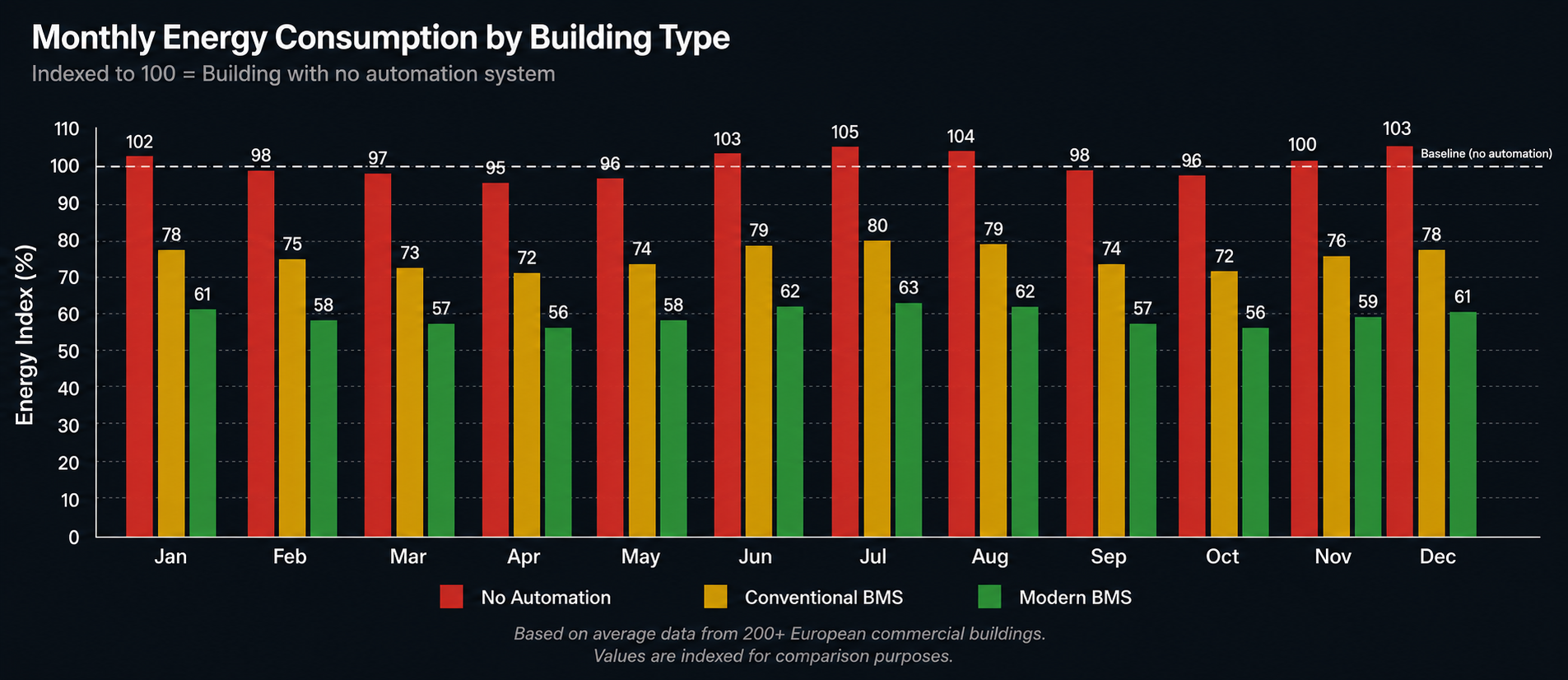
Monthly Energy Consumption by Building Type
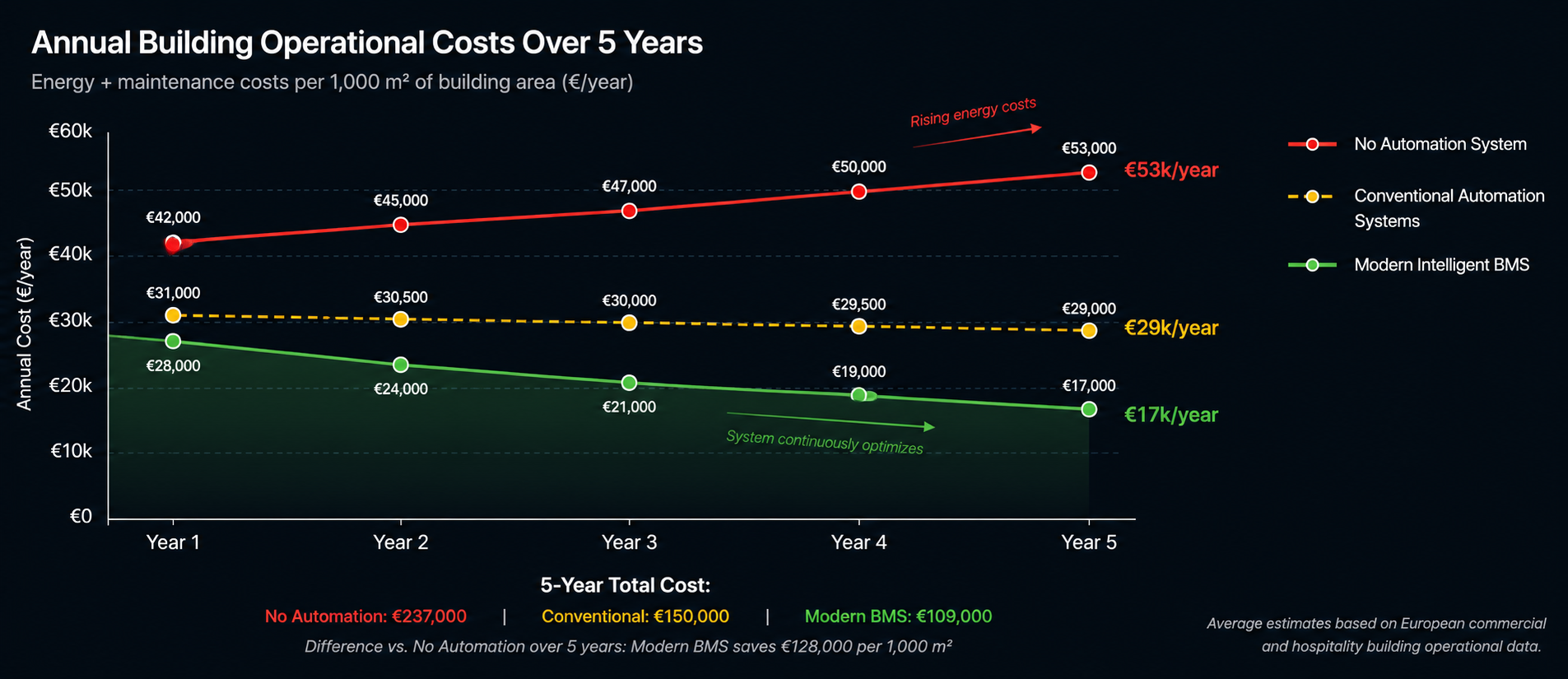
Annual Building Operational Costs Over 5 Years
What Modern Building Management Systems Change
Building Management Systems (BMS) — Key Capabilities
Predictive Maintenance
Modern BMS analyzes equipment performance patterns and detects potential failures 2–4 weeks in advance.
68% fewer emergency repairsSelf-Learning Climate Control
The system learns occupancy patterns, weather conditions, and usage behavior over time. Optimal comfort — automatically.
25–30% less energy for HVACDynamic Energy Load Balancing
Real-time redistribution of energy loads based on tariff periods, occupancy levels, and available energy sources.
Up to 20% savings on energy billsContinuous Anomaly Detection
Modern BMS monitors 500+ parameters simultaneously and detects deviations before they become critical failures.
Response time: seconds, not hoursRenewable Energy Integration
Intelligent coordination of solar panels, battery storage, and grid connection. The building uses energy when it is cheapest and optimizes surplus when prices peak.
Full renewable energy compatibilitySingle Control Point for the Entire Building
All building systems — HVAC, lighting, access control, fire safety, elevators, and IT infrastructure — managed from one unified platform. One screen. Full visibility.
100% system integration — zero blind spotsOur BMS Solutions: From Concept to Operation
Building Management Systems (BMS) — Full Cycle Engineering
We don't sell products — we engineer complete intelligent building management systems, designed around the specific needs of each facility. Every solution we deliver is built for long-term performance, energy efficiency, and seamless scalability.
BMS Design & Engineering
Full system design from scratch — architecture, sensor placement, control logic, integration strategy. We design for today's needs and tomorrow's requirements.
Room Management Systems (RMS) for Hotels
Automated guest room control: climate, lighting, power supply, do-not-disturb and make-up-room modes. Full integration with PMS platforms including OPERA and FIAS.
HVAC Automation & Optimization
Intelligent heating, ventilation, and air conditioning management with occupancy-based control and seasonal adaptation. Average energy reduction: 25–35%.
Energy Monitoring & Reporting
Real-time energy consumption dashboards, automated reporting, threshold alerts, and consumption analysis by zone, system, and time period.
Lighting & Access Control Integration
Presence-based lighting control with daylight harvesting, scene management, and full integration with access control and security systems.
Legacy System Modernization
Connecting existing older automation infrastructure to modern BMS platforms — without full replacement. Extend the life of your investment while unlocking modern capabilities.
Is Your Building Working for You — or Against You?
Every month without intelligent building management is money lost and energy wasted. We will analyze your current systems, identify inefficiencies, and show you exactly how much you could save — with real numbers, not estimates.